Place more than time: The sensory experience of two sculptural collages
Paper presented at “Space Oddity: On spatial Narratives”, XII Graduate Conference in Culture Studies Universidade Católica Portuguesa, Lisbon, 2024
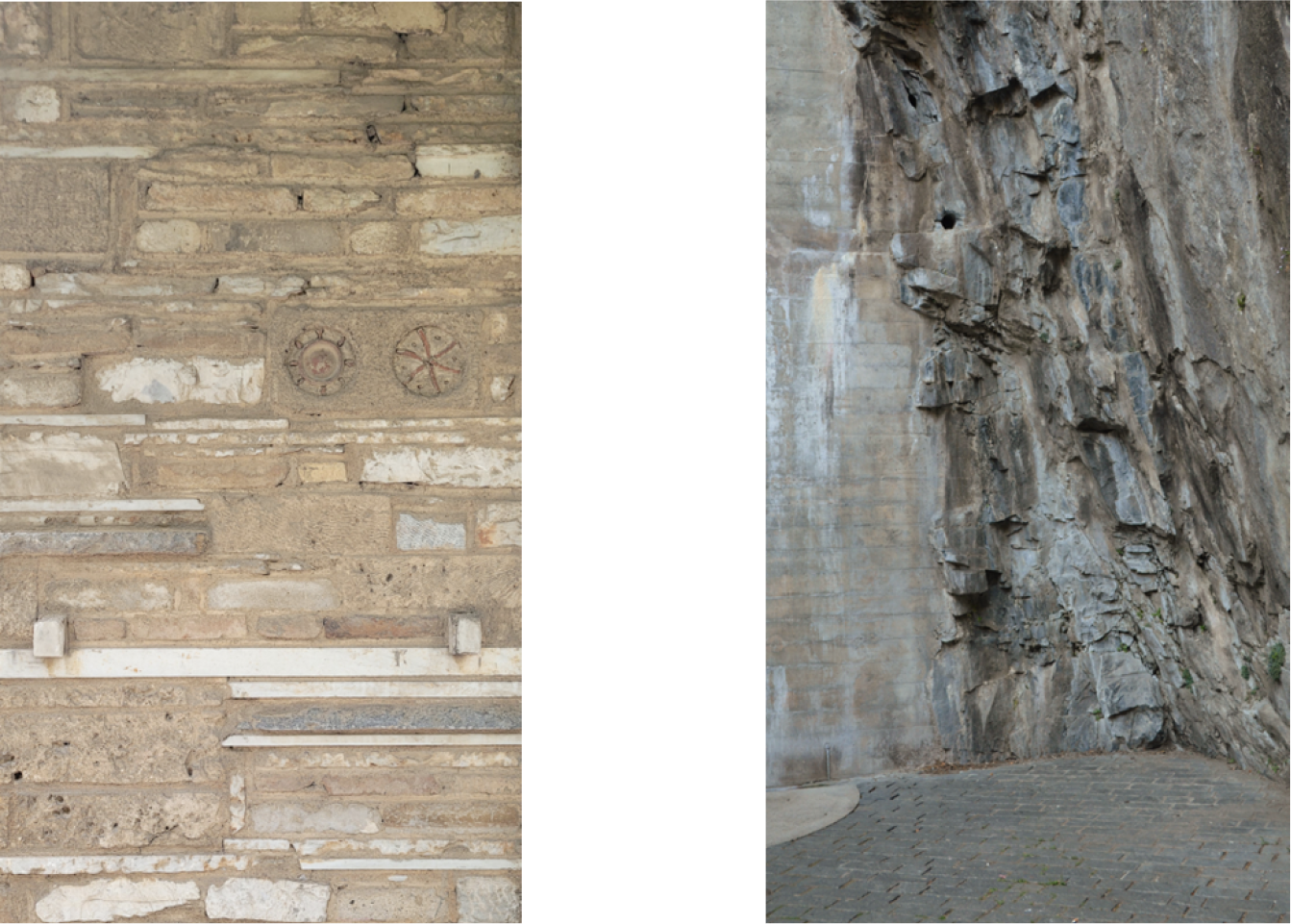
Parts of the facades of St. Demetrius Loumbardiaris in Athens, Castelgrande in Bellinzona
© Thomi Kordonouri
ABSTRACT
Spatial narratives are often interwoven and communicated through a collage, a composition that evolves through successive dwellings and transformations over time. This collage serves as a canvas where various places and their memories are symbolized through its components, which act as cognitive structures, each expressing its narrative through materiality, architectural forms, or other sensory stimuli embedded within the surrounding space. Also, they serve as potent catalysts for memory, invoking a profound connection with the past, and inviting viewers to reflect on the layers of history and stories embedded within the spatial fabric.
This paper introduces two sculptural collages that offer a multi-sensory experience of space and examines their contribution to a better understanding of a place. The first case study is the work of Castelgrande (1981-1991) in Bellinzona by Aurelio Galfetti, who transformed the fortress into an urban park focusing on the sense of place and its geography, rather than chronological restoration. The second case is Dimitris Pikionis’s pathways of the Filopappou Hill and Acropolis surrounding area (1957) in Athens, including the church of St. Demetrius Loumbardiaris (1951), who composed a collage of reused fragments of Byzantine and neoclassical buildings, shaping a continuum of the place’s history.
Through a comparative analysis of the aforementioned works of critical regionalism which both offer a haptic and walking experience, this paper contributes to the discussion on spatial narratives. It argues that sculptural collages create a sensory richness that allows visitors to engage not only visually, but also through other senses, understanding a place’s identity through a holistic experience.